

Blog

Documenting Your Vote: Ohio Election Laws

Continuing our focus on swing states, I'll look today at the laws regulating polling place activities in Ohio. These laws may impact your ability to document your own voting experience through video and still photography, as well as your ability to carry out other newsgathering functions, such as interviewing other voters outside of polling places.

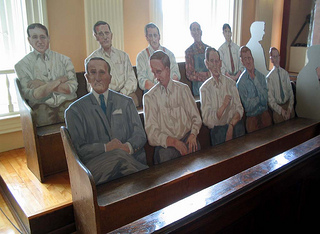
Ohio law does not expressly prohibit using a camera or video recorder inside a polling place while you are voting.  Section 3501.35(B) of the Ohio Revised Code states that no person other than an election official, employee, observer, or police officer may enter a polling place "except for the purpose of voting or assisting another person to vote." This could mean that any activity other than voting is prohibited, but the language does not compel this result. The photo above and others like it suggest that at least some Ohio poll workers allowed voters to take photographs inside of polling places during the 2008 Primaries.   read more »

Will Your ISP Stand Up for Your Free Speech Rights?

There are a lot of things to consider when making the decision to launch a blog or website, including questions of cost, ease of use, and ownership of content.  Understanding how these considerations impact your legal rights and potential liability can help you make an intelligent choice as to what platform to use and what precautions to take when you speak online (we've got a whole section on these concerns, and others, in our legal guide).  But one area most people tend to overlook is whether their prospective ISP or hosting provider values -- and is willing to stand up for -- free speech rights.  

In a fascinating post on Public Citizen's Consumer Law & Policy Blog, Paul Alan Levy recounts a disturbing series of events that led to the repeated takedown of Ronald Riley's "gripe site" about the infamous "cyberlawyer" John Dozier, www.cybertriallawyer-sucks.com.  Paul's cautionary tale highlights the importance of assessing -- before you are embroiled in a legal dispute -- whether your ISP or hosting provider will stand up for your free speech rights.    read more »

Oregon Shield Law Protects Anonymous Commenter

Last week, an Oregon state judge ruled that Oregon's media shield law, found at Or. Rev. Stat. §§ 44.510 to 44.540, protected the identity of an anonymous commenter who posted allegedly defamatory statements on the Portland Mercury and Willamette Week websites.

According to the Portland Mercury, staff writer Amy Ruiz wrote a post in January 2008 about Portland mayoral candidate Sho Dozono.  In the comments section, a site user going by "Ronald" posted negative comments about Dozono's ties to a local businessman, Terry Beard.  The same commenter allegedly posted similar statements on the Willamette Week site. Beard filed a motion to compel the two online newspapers to give up "Ronald's" IP address before an Oregon state court.  The two competitors teamed up to oppose the discovery request and won.   read more »

Documenting Your Vote: Florida Election Laws

This post is another in our series looking at state election laws that regulate activities at polling places on Election Day.  These laws, which we cover from a general standpoint in the Documenting Your Vote section of our legal guide, may impact your ability to document your own voting experience through video and still photography, as well as your ability to carry out other newsgathering functions, such as interviewing other voters outside of polling places. Florida is sure to be a center of attention come November, given its swing-state status and notorious history. In this post, I'll look at how Florida's election laws affect these activities.   read more »

Introducing Guest Blogger Marc Randazza

I'm excited to welcome Marc Randazza, a noted First Amendment lawyer, as a guest blogger. Regular readers of this blog will recognize Marc as the often irreverent author behind The Legal Satyricon, a blog focused on law, technology, and politics.  For his “day job,” Marc practices with the law firm of Weston, Garrou, Walters & Mooney, where he focuses on First Amendment, intellectual property, Internet, and gaming law.

Marc has represented clients in a number of citizen media-related cases, including Veranda Partners v. Giles, Lexington Homes v. Siskind, and Internet Solutions v. Marshall.  He also served as counsel to Anthony Ciolli in the early stages of the AutoAdmit case. We posted recently about his big victory in the Giles case.   read more »

in

Documenting Your Vote: California Election Laws

The CMLP is currently doing research on the state laws regulating activities at polling places on Election Day.  Our specific focus is on laws that impact voters' ability to document their own voting experiences through video and still photography, as well as their ability to carry out other newsgathering functions, such as interviewing other voters outside of polling places.  In this post, I'll look at how California's election laws affect these activities.

The California law with most immediate relevance to citizen media creators who want to document the vote is California Elections Code § 18541.  This statute makes it a crime for anyone, within 100 feet of a polling place, to "photograph, videotape, or otherwise record a voter entering or exiting a polling place" with "the intent of dissuading another person from voting." The 100-foot zone is measured from the interior voting area itself, not from the exterior of the building; so most of it will likely be inside the polling place.

Because section 18541 requires intent to dissuade someone from voting, it does not appear to ban outright the use of cameras and recording equipment in the 100-foot zone. But it does make such activity risky.  Your intent is invisible. While you may not have any intention of dissuading anyone from voting, poll workers might see your conduct differently than you do. You could ultimately prevail before a court if the state chose to prosecute you, but you might still get kicked out of the polling place on Election Day and/or have to deal with some gigantic legal hassles.   read more »

Skype Cannot be Trusted, Period

As Salon notes in "Skype sells out to China," the eBay-owned service has collaborated with a Chinese company to enable spying on the allegedly encrypted messages that Skype users send each other to and from, and within, China. This disgusting sellout should surprise no one.

Skype and its corporate parent, eBay, have been evasive about whether the product is truly secure. There’s ample reason — including this admission attributed to an Austrian law-enforcement agency — to suspect that the company has created backdoors for police.

Skype, for its part, has never outright denied that it has done so. Nor has it shown its encryption algorithms in an open way to outside experts for verification and analysis. I take this as an admission that you can’t trust Skype’s encryption, period.

This is important to citizen-media people for several reasons. First, plenty of regimes make it downright dangerous to indulge in truly free speech. Skype has been a favored tool for many people who believed the built-in encryption somehow would protect them.

Second, it’s another example of the way companies from the West collaborate with the globe’s most dictatorial regimes — and it makes abundantly clear that we need an open-source communications toolset that we can trust.

Skype is better than no encryption at all. But do not imagine for a minute that you can fully trust this company, because you can’t.

Big Media Challenges Constitutionality of Minnesota Polling Restriction

ABC, NBC, CBS, CNN, Fox News, and the Associated Press have joined forces to challenge a Minnesota statute that forbids non-voters to stand within 100 feet of the entrance to a polling place on election day.  In their complaint, the media companies allege that this restriction, as applied to their planned exit polling activities, violates the First Amendment.

The law in question, Minnesota Statutes § 204C.06(1), says:

An individual shall be allowed to go to and from the polling place for the purpose of voting without unlawful interference. No one except an election official or an individual who is waiting to register or to vote shall stand within 100 feet of the entrance to a polling place. The entrance to a polling place is the doorway or point of entry leading into the room or area where voting is occurring.

The Minnesota legislature amended the law in April 2008; the previous version measured the 100 foot zone from the room inside the polling place where voting took place.  Under the previous law, in 2004 and 2006 media representatives apparently engaged in exit polling immediately outside or within approximately 25 feet of the outside door to polling places in Minnesota.

The media organizations argue that the new 100 foot restriction will significantly impair their ability to engage in accurate exit polling because voters are more likely to get into a car and drive away before reaching the 100 foot mark, because it becomes harder to distinguish voters from non-voters as the distance increases, and because it becomes impossible to select polling subjects in a scientifically selected pattern at this distance (thus undermining their sampling methodology).     read more »

Trademark Filings as Economic Indicators?

Now this is interesting.  The Philadelphia Inquirer reports in an article entitled "What trademarks say about economy," that

[w]hen trademark filings are up, it's a good sign that the economy is humming along. But if they go up too fast, you may have a bubble on your hands. Or if they start to tail off after years of modest growth, there might be a recession in the offing.  "We are seeing applications now in 2008 going down, but they are dropping less sharply and fiercely than they did in late 2001," during the last recession, said [Glenn] Gundersen [a trademark and copyright lawyer at Dechert L.L.P.]

According to the Inquirer, trademark filings hit an all-time high of 287,000 in 2000, but then fell off more than 25 percent the following year.  "It wasn't until 2007 that they finally passed the record set in 2000 by topping 300,000. Since then, filings have declined slightly, less than 2 percent for the first half of this year, compared with the same time last year, nowhere near the precipitous drop of the last recession."

Maybe things aren't quite as bad on the economic front as events this past week would lead us to believe?

(Thanks to Marty Schwimmer at The Trademark Blog for alerting us to this.)

Car Dealership Appeals ConsumerAffair's CDA 230 Win

New York-based Nemet Chevrolet filed a notice of appeal to the Fourth Circuit last week, challenging a district court's dismissal of its amended complaint against ConsumerAffairs.com based on section 230 of the Communications Decency Act (CDA 230). The appeal presents some interesting questions about whether a website loses CDA 230 immunity by encouraging negative consumer commentary and using drop-down boxes to enable users to categorize their submissions.  To my knowledge, this is the first federal appeal raising these issues since the Ninth Circuit's controversial decision in Fair  Housing Council v. Roommates.com, LLC, 521 F.3d 1157, 1175 (9th Cir. 2008).   read more »

Aerosmith's Steven Tyler Sues Cyber-Impersonators

Aerosmith singer and generally-uber-famous-person Steven Tyler filed a lawsuit Wednesday against anonymous bloggers who allegedly impersonated him and his girlfriend Erin Brady. Tyler's complaint includes claims for false light invasion of privacy, publication of private facts, and misappropriation of likeness (a.k.a. right of publicity).  It requests damages and an injunction prohibiting the defendants from further misappropriating Tyler's name or likeness or implying that they speak for him.

The defendants allegedly created a pair of Blogspot blogs that purported to be the personal musings of Tyler and his girlfriend.  The blog tylers849021.blogspot.com (now removed, but still accessible via Google Cache) included photos of Tyler along with largely G-rated accounts of Tyler and Brady's relationship. The blogger or bloggers posted under the name "STEVEN" and signed each post "ST."  A similar blog -- shelikespurple.blogspot.com (also removed but accessible through Google) -- operated the same way but offered Brady's perspective.  read more »

YouTube Anti-Scientology Takedowns and Putbacks

The Electronic Frontier Foundation reports on some good news, and bit of bad news, regarding the blizzard of DMCA takedown notices sent to YouTube on behalf of the Church of Scientology. Back in early September, the American Rights Counsel, Schaper Company, and Media House Enterprises, among others, sent hundreds of takedown notices to YouTube demanding the removal of videos critical of the Church of Scientology.  According to EFF, "[i]t soon became clear that these entities did not hold the copyrights to the materials they claimed to be infringed, including footage from a Clearwater City Commission meeting and a man-on-the-street interview. In addition, many of these videos were obvious fair uses, such as independent news reports."

If inappropriate DMCA takedowns don't surprise you -- and they shouldn't (if you've been reading our blog, you know that misuse of the DMCA is widespread) -- YouTube's response might just put a smile on your face.  As EFF reports,

YouTube quickly realized something was fishy, and began investigating. Within days, YouTube suspended the accounts that had sent out the allegedly fraudulent DMCA takedown notices, reinstated the accounts that had been suspended for multiple allegations of copyright infringement, and put most of the videos back up on YouTube, all without waiting to receive DMCA counter-notices from YouTube users who had had their videos taken down.   read more »

Marc Randazza: First Amendment Juggernaut

My good friend Marc Randazza has given me the green light on an exciting piece of news.  On September 11, 2008, Florida Circuit Court Judge George Sprinkle entered a default judgment in favor of Randazza's client Larry Giles, operator of the Veranda Park News, an online newspaper offering observations and commentary on events and aesthetic issues in Giles's development community.  The court awarded Giles approximately $180,000 in treble damages under one of Florida's anti-SLAPP statutes, Fla. Stat. § 720.304 (4), which protects homeowners who engage in petitioning activity in matters related to their homeowners' associations.

On the receiving end of the default judgment is Veranda Partners, LLC, a large real estate developer who owns a controlling interest in the Veranda Park development in Orlando where Giles owns a home.  The developer sued Giles in 2007, complaining that statements appearing on his website were defamatory.  Allegedly, Giles published statements indicating that Veranda Partners misspent homeowners' dues, changed landscaping to unfairly enrich itself, and partnered with the City of Orlando in order to gain an unlawful business advantage.   read more »

New Insurance Program for Bloggers Offered by the Media Bloggers Association

Here is a simple, but often ignored, truth: if you publish online, whether it's a news article, blog post, podcast, video, or even a user comment, you open yourself up to potential legal liability.  It doesn't matter whether you are a professional journalist, hockey-mom, or an obscure blogger, if you post it, you'll need to be prepared for the legal consequences. 

Civil Lawsuits by Year of Filing So how big are the legal risks?  It depends on what you publish and how you go about doing so.  If you publish a blog about cute cats, for example, your risks are going to be lower than they would be if you run a website focused on local police corruption.  Over the next few weeks we'll attempt to quantify and analyze these risks by digging into our legal threats database, but even at this preliminary stage, we can say that the threats directed at online publishers have clearly been increasing.  As the figure to the right shows, in the last 10 years, the number of civil lawsuits filed against bloggers and other online publishers have increased from 4 in 1997 to 89 in 2007.

While most lawsuits never get to trial, even frivolous suits dismissed at a relatively early stage of the litigation can be expensive to defend.  Unfortunately, if you lack the money to carry out a vigorous defense, your only option may be to settle (perhaps agreeing to take down the offending content or even your entire site) regardless of the merits of your defense.   read more »

CMLP Teams Up With NewsU to Launch Online Media Law Course

We're pleased to announce that News University launched its Online Media Law course today.  The course is specifically designed for individuals and journalists engaged in online publishing, and it covers three important areas of media law -- defamation, privacy, and copyright. The course is free. Students can enroll online at the NewsU site and take the course at their own pace. 

CMLP Director David Ardia co-authored the course with Geanne Rosenberg, Chair of the Department of Journalism and the Writing Professions at City University of New York’s Baruch College.  The course was created at the behest of the Media Bloggers Association (see MBA's announcement).  You can see NewsU's official press release here.

(Note: News University is funded by the Knight Foundation, which also provides funding for the CMLP.) 

Virginia Supreme Court: State Anti-Spam Law is Unconstitutional

It looks like Jeremy Jaynes, the first person in the United States to be convicted of a felony for spamming, is going to get a free pass, thanks to a decision handed down by the Virginia Supreme Court last week striking down Virginia's anti-spam law, Va. Code Ann. § 18.2-152.3:1, on First Amendment grounds. 

The Virginia law states that anyone who accesses a server "with the intent to falsify or forge electronic mail transmission information . . . in connection with the transmission of unsolicited bulk electronic mail through or into the computer network of an electronic mail service provider" is guilty of illegal spamming.  Under the statute, the crime can be either a misdemeanor or a felony depending on the amount of spam email that the spammer attempted to send.  (Jaynes was found guilty of the felony version in 2004, according to the Associated Press, due to his sending an average of 10 million spam emails per day.)

In a unanimous decision, the Virginia Supreme Court ruled that the state's anti-spam law necessarily infringes on the First Amendment's protection of anonymous speech.  The court wrote that "because e-mail transmission protocol requires entry of an IP address and domain name for the sender, the only way such a speaker can publish an anonymous e-mail is to enter a false IP address or domain name."  But by making such a falsification illegal, the court ruled, the Virginia statute "infringes on that protected right" of anonymous speech.   read more »

YouTube Changes Guidelines, Senator Lieberman Gets Partial Victory on Terrorist Videos

Taking full advantage of the seventh anniversary of 9/11, YouTube announced changes to its community guidelines last week, prohibiting the upload of videos inciting others to commit violent acts.  The change comes several months after Senator Joe Lieberman pressured YouTube to remove videos not only inciting violence, but also content "that can be readily identified as produced by Al-Qaeda or another [Foreign Terrorist Organization]," through logos such as these:   read more »

Libel Tourism: A First Amendment Holiday

Over the past few months, I've blogged several times (see here and here) about the proposed federal Free Speech Protection Act of 2008, which would allow a federal court to enjoin the enforcement in the United States of a foreign libel judgment if the speech at issue would not constitute defamation under U.S. law.  "Libel tourism" describes the practice of libel plaintiffs who pursue claims against American publishers in foreign courts that offer few, if any, of the protections for speech available in the United States.    read more »

Jones Day Gets Trademark Law Wrong, Squelches Legitimate Reporting

Paul Alan Levy of Public Citizen published a fantastic post on Friday about big law firm Jones Day's lawsuit against BlockShopper.com, an online real estate news website covering Chicago, South Florida, Las Vegas, and St. Louis. The website reports on what's happening in the local real estate markets -- who's buying, who's selling, where, what price, etc.  It focuses on fancy neighborhoods where lawyers and other professionals frequently buy homes and often mentions the professional affiliations of the buyers and sellers.  The lawsuit arose out of BlockShopper's reports on two condominium purchases by Jones Day associates Dan Malone Jr. and Jacob Tiedt.  In the reports, BlockShopper used Jones Day's trademark (its name) to identify the law firm as Malone and Tiedt's employer and linked from each associate's name to their biographies on the firm's website (here and here).  Levy aptly characterizes the absurdity of Jones Day's claims:   read more »